A quick introduction and guidance into having a Photovoltaic (PV) system installed based around a 1kwp (the peak output) system:-
What a PV system gives to the customer is the satisfaction that they are producing some of their own energy and they can also, now, or in the future, upgrade to a storage, or backup system giving a degree of energy security and some control over their supply. Whatever system you install you will be lowering your carbon footprint.
- A 1kwp system will cost around £2,500
- A 4kwp system will cost between £6,000and £10,000 depending on the ease of installation and the make of panel and inverter specified. Using premium panels will price it nearer the top end. An 8kW peak system is not double a 4kW, it is around £13,000 to £15,000 with mid price or premium materials. A 4kwp system will produce around 3400kwhrs a year in the south of England (Energy Saving Trust) but this will vary from year to year depending on the weather.
- 1kwp will cover about 5.5 square meters of roof area with the lower cost panels and about 4.5 square meters with more efficient (and more expensive) panels.
- 1kwp system in Gloucestershire will deliver about 850kwhrs of electricity in a year.
- A typical 4kW peak system will take 3 days to install and commission
- A typical house in 2025 will use 3500kwhrs/year of electrical energy, in 2030 with a heat pump for heating it will be about 12,000kWh/year.
- The system should ideally face South to target the maximum annual generation, but east to west will be better to target your use for most of the year. – see tilt and orientation guide. Alternatively you may wish to target a morning, afternoon, or winter load so panels facing in different directions or at a steeper angle will ensure generation to meet target load times. As an example panels inclined at a steeper 55 degree angle south facing, will produce much more energy in December and January than panels set at 30 degrees. These days with no Feed in Tariff it makes more sense to target your load so additional panels facing east/west and/or a steep angle south facing provide energy at targeted times.
- The ideal roof pitch to give maximum annual generation is 30-35deg, traditional pitches of 45º and 55º make only a few % difference in annual output – see tilt and orientation guide. As said earlier you may wish to target a higher output in winter rather than the maximum annual figure, for this a steeper angle is better to catch the lower sun angle. Again, see Tilt & Orientation chart.
- Space for the inverter, typically outside these days for cooler operation, and the total generation meter near your distribution board.
- The system is fully automatic and will generate electricity when the light arrives.
- When the electricity supply fails generation stops, so your system does not electrocute the man on the wire repairing the supply! Then it automatically starts working again after the grid supply returns and becomes stable. The system can be adapted to provide a backup supply in the event of grid failure. This involves a different, or additional inverter, more wiring and batteries.
- Installing a solar PV system on a roof is a “Permitted Development” (excluding Listed Buildings) provided it is less than 200mm above the roof plain and complies with the General Permitted Development Order. AONB’s are not “Conservation Areas” in “planning terms” so even in AONB's solar panels on the roof are a permitted development. In “Planning Conservation Areas” solar systems do not need planning permission if they are on the roof, however if they are on the walls and can be seen from the highway Planning Permission will be required. Ground mounted systems larger than 9m2 also require planning permission.
- The installation price guidance above takes into account scaffolding, but not any building specific problems or any electrical wiring changes that may be required to your particular building.
- Solar tracker systems are another way to increase energy production for any given size of system. These can be either a "daily" tracker (Heliomotion) that follows the path of the sun each day - These systems give very high output for a small area and produce useful amounts of energy for a longer period of the day compared to standard fixed systems.
The other is a "seasonal" tracker (Cornish Rocker) that can be manually adjusted to face the sun as it is higher in the sky in Summer and lower in Winter. These systems can produce more energy over the years than a fixed system of the same size due to the fact the panels are in the best position to gather sun energy throughout the year.
Large systems - please contact us to talk through your project.
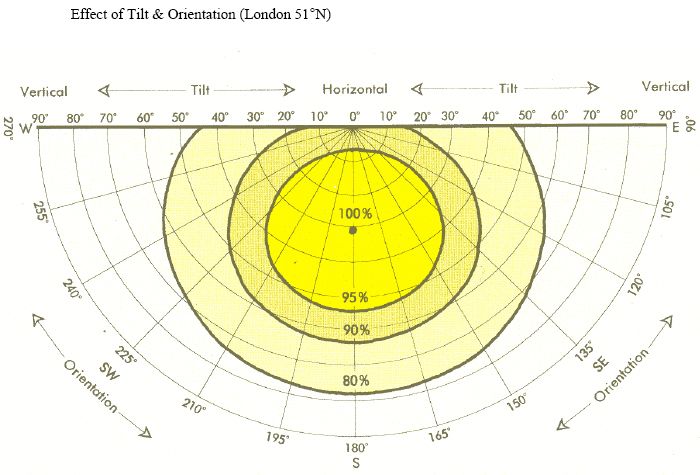
Tilt & Orientataion

Heliomotion
