Sunny Thoughts
Sunshine for the Consumer
Energy and the future.
The first thing is to look at your energy use, what can you do to reduce your consumption? Insulation is the first thing, often not easy to do but once done the effectiveness lasts a long time. Consider after 2030 you will not be able to replace a fossil fuel boiler, so an option is a heat pump, this uses electricity so is many times more expensive to run. If your building is well insulated you could run the heat pump in daylight hours from your PV system and you will not loose too much heat overnight – a double win! Change to LED lighting which consumes a great deal less energy, when you add battery storage this will make the stored energy last much longer. Finally examine your lifestyle and energy usage pattern, could you make changes to consume energy when its daylight.
PV After the Feed in Tariff - FiT RIP!
No longer is the solar purchaser looking solely for a financial a return on investment, they are looking to reduce their exposure to energy price increases and for future energy security. The current payment for exporting energy is variable dipending on supplier, 6p/kWh to 15p/kWh at peak times, so when you are buying energy for between 25-36p/kWhr and likely to increase even more, it makes more sense to generate some of your own and to change usage patterns to use it at the time of generation, put the washing machine on, charge the electric car etc when the sun shines. To maximise use of your own energy even more you could fit an energy diverter to divert any energy export into heating water, charge your electric car, or install a storage battery to store it during the day for overnight use.
System Design
The original design ideas developed following the introduction of the Feed in Tariff was to generate as much as possible over the year, this drove the ideal system design along the lines of a south facing roof at a pitch of 30º, that maximised the total annual generation but gave a bell shaped generation curve peaking at 12 midday. This is likely, domestically, to be the time of least use, and commercially a low morning and evening generation is of little use when consumption is steady all the working day. With this principle in mind we now need a re-appraisal of the design of the system. Now and in the future, it represents a better saving to have energy generated when you want it, so it could be better to look at other orientations and other angles dismissed under the “old thinking”. Customers obviously work with the roofs they have and often have roofs and panels facing in different directions, this suits the shape of the building and spreads the generation period. Monitoring is particularly important as it gives you information and the knowledge to make changes in the future, lifestyle and to the installation to live with the planet and get the most out of your system. Online connection also offers online maintenance support, useful as the system ages.
What is ideally needed for the winter months is panels facing south and set at a steeper 50º pitch, in the depths of winter the sun rises in the south east, is low in the sky at midday, and sets in the south west. This a disadvantage in the summer because it misses the early morning and the later evening sun, so for mid-summer east and west is best. Nothing is ever straight forward! As you see the design is a compromise trying to target your specific requirements and your building. Commercial systems prefer an east/west layout to lengthen the generation period. Customers are even puting panels on north roofs these days because on a cloudy winter day it makes little difference which direction the panels face, and it maximises the daily output - particularly in winter it is a significant contribution.
Listed Buildings
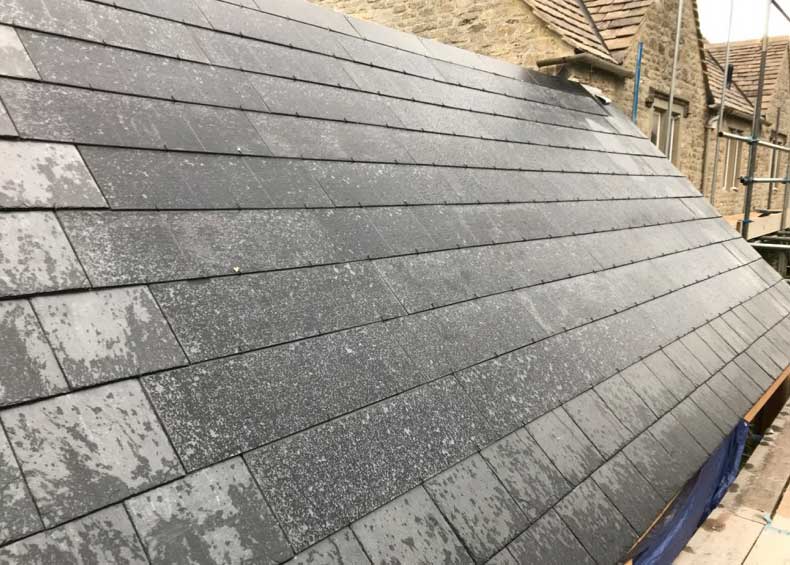
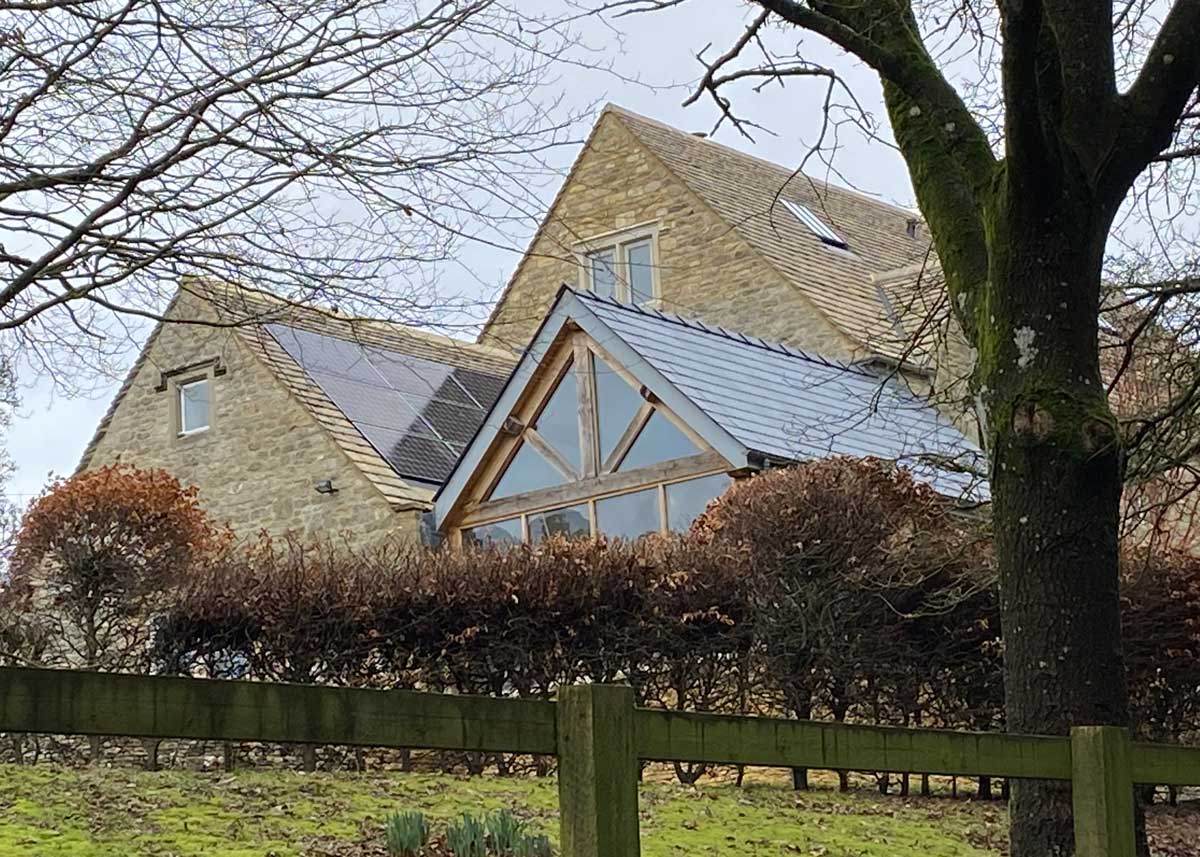
These are a challenge from the Listed Building Planning perspective but they must be dealt with to overcome the risk they will become monuments, not homes. If a building can’t be economically made warm and cosy the occupants will move out and it will decrease in value as a home, and become “a building”. A current proposal for Building Regulations is that all dwellings should have a minimum EPC Rating of “C” which currently will render most Listed Buildings as uninhabitable! Below is a Listed building with an installation done recently, the front roof is 1.9kW peak of solar slates and the roof behind is 4kW peak of panels.
Storage
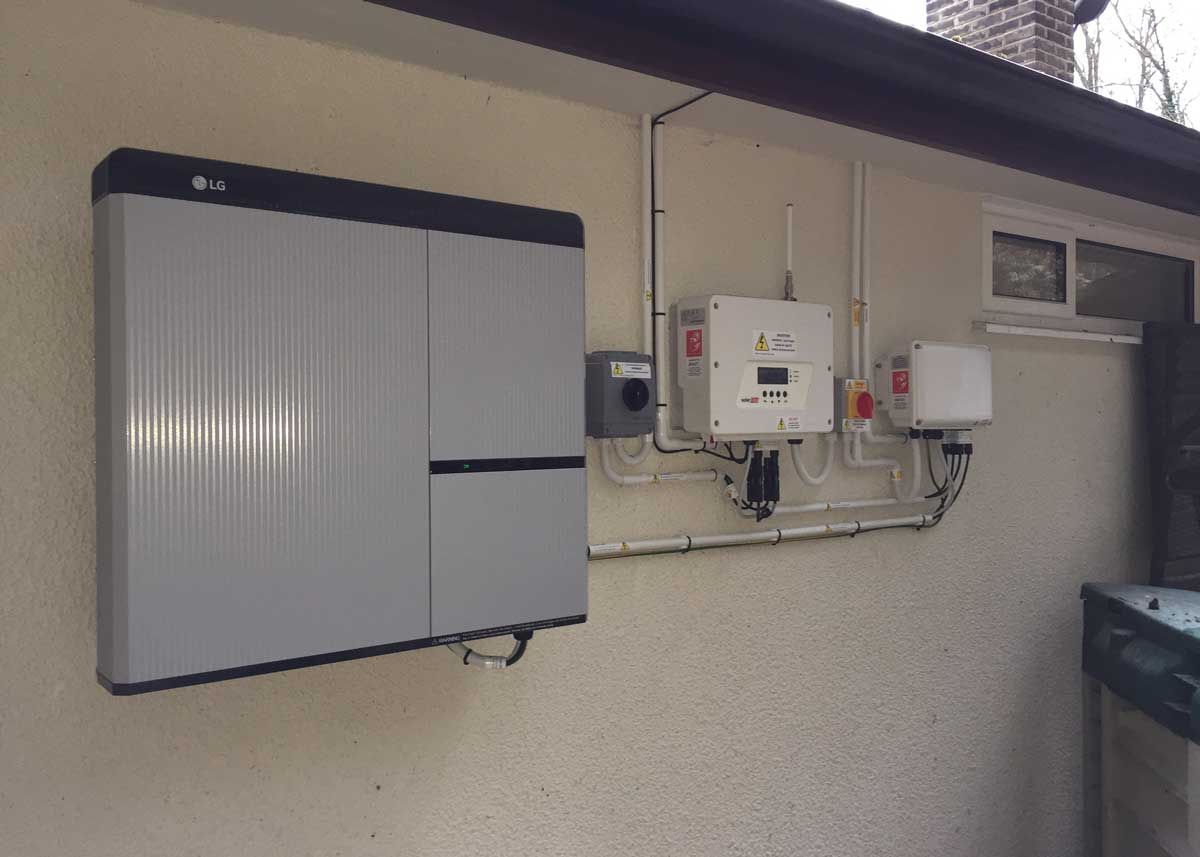
If you have solar system that faces south a good energy saving move would be to add a diverter to heat a hot water tank, divert to your electric car, or to battery storage. The midday generation peak can then be stored and used later or overnight. The battery storage will then be empty again and ready to store the next days sun peak. A hot water diverter or EV Charger diverters are relatively cheap to add so are very cost effective, particularly the smart EV charger because it offers free motoring! However a storage battery is relatively expensive so you need to monitor your system, or design for surplus energy, over the daytime to make it cost effective, at least from March to September. If lifestyle and consumption prediction is not clear we usually suggest putting the PV system in and monitoring it to confirm the exported energy is at least the size of the storage battery so you are sure the money is well spent, if not add more PV.
Adding storage can influence the solar system size. If a larger PV output is installed, good for additional energy anyway, the surplus energy will recharge the batteries. A bigger solar system is particularly beneficial on the shorter days in the winter to make the most of the shorter daylight hours.
What all this illustrates is the need to consider the energy requirements when designing a solar system. In a typical situation the roof might already exist, so there is little design flexibility but with the knowledge of the sun-path and the energy requirements, the most appropriate design can be arrived at, and the building owner can understand the issues and what compromises need to be considered. All buildings will benefit from solar energy, the system just needs to be designed to maximise the output at the times there is a demand, or stored until needed. Another point to note these days is as solar panels improve efficiency in diffused light and lower light levels, on overcast days even north facing panels will produce as much as south facing panels. In certain situations, the extra energy on dull days is useful, particularly in winter.
Looking into the future
Considering the bigger picture, the electricity supply network operators will have less problems with solar systems that are targeting the demand and giving a flatter generation profile during daylight hours. They don’t want a large generation peak from every system in the district at midday! – which they then have to deal with on grid. Storage will also further help them by buffering both the generation peaks and the demand peaks. The more you can help by generating some of your own needs the more secure the future will be everybody.
Export Limitation - Another helpful technology is the development of export limitation. This means that given the roof space, a much larger system can be installed to meet the building demand but the maximum export to the grid can be limited to meet the requirements of the District Network Operator. This principle is helpful in domestic or commercial situations and to meet a working week day demand but still cope with a weekend shut down. Also domestically a higher winter demand can be met but then still control the maximum export for the DNO requirement in the summer.
To sum up we will discuss with the building owner to establish what is required and then propose a system that best fits the site, the usage pattern, and the budget. Typical system sizes used to be up to 4kW peak but these days with the demise of the FiT payment typical domestic system sizes are 4 to 10kW peak, with export limitation if necessary to meet the Network Operators maximum allowance. The default permitted export limit is 3.68kW/phase (16 amps) and prior permission has to be obtained to exceed this. In most cases this is allowed, but if not export limitation is programmed in.
Most businesses operate in the daytime so their energy consumption occurs at the same time as the solar energy generation, a perfect demand matching supply time, all we need to do now is the calculations to make the amounts add up.
As with domestic systems a bell curve with peak generation at midday from a south facing system is not as useful as a system facing east/west giving a much flatter generation curve. Take for instance a business working from 8.00am to 6.00pm, it makes no sense to have a south facing only system which gives a gradual energy increase peaking at midday, and tailing off in the afternoon. What would be better commercially is to have a system with east and west facing panels at a low angle that will give generation earlier in the morning and later in the afternoon, and much flatter whole day generation profile.
Financially there is nothing business hates more than unpredictability! Adding solar generation to the roof of the building reduces the outgoing cash flow and adds insulation against future energy cost increases. Once the capital cost is covered the solar system will not only produce free energy for the business to use for probably in excess of 30 years, it will reduce the outgoing annual costs and insulate business cash flow from the vagaries of the energy market. Most premium panel manufacturers now offer a full 25 year guaranty with SunPower now offer a 40 year guaranty.
From a publicity perspective it will also indicate significant business social and climate responsibility, and prestige, offering CSR (Corporate Social Responsibility), and reducing carbon emissions.
A Sunny Future for Business
Most businesses operate in the daytime so their energy consumption occurs at the same time as the solar energy generation, a perfect demand matching supply time, all we need to do now is the calculations to make the amounts add up.
As with domestic systems a bell curve with peak generation at midday from a south facing system is not as useful as a system facing east/west giving a much flatter generation curve. Take for instance a business working from 8.00am to 6.00pm, it makes no sense to have a south facing only system which gives a gradual energy increase peaking at midday, and tailing off in the afternoon. What would be better commercially is to have a system with east and west facing panels at a low angle that will give generation earlier in the morning and later in the afternoon, and much flatter whole day generation profile.
Financially there is nothing business hates more than unpredictability! Adding solar generation to the roof of the building reduces the outgoing cash flow and adds insulation against future energy cost increases. Once the capital cost is covered the solar system will not only produce free energy for the business to use for probably in excess of 30 years, it will reduce the outgoing annual costs and insulate business cash flow from the vagaries of the energy market.
From a publicity perspective it will also indicate significant business responsibility prestige with its visible environmental responsibility, CSR (Corporate Social Responsibility), and reducing carbon emissions.
A very appropriate quote from John Ruskin (1819-1900) on price and value
...little has changed in the principles of business over the last 120 years!
"There is hardly anything in the world that someone cannot make a little worse and sell a little cheaper, and the people who consider price alone are that person’s lawful prey.
It’s unwise to pay too much, but it’s worse to pay too little. When you pay too much, you lose a little money – that is all. When you pay too little, you sometimes lose everything, because the thing you bought was incapable of doing the thing it was bought to do.
The common law of business balance prohibits paying a little and getting a lot – it can’t be done. If you deal with the lowest bidder, it is well to add something for the risk you run, and if you do that you will have enough to pay for something better."